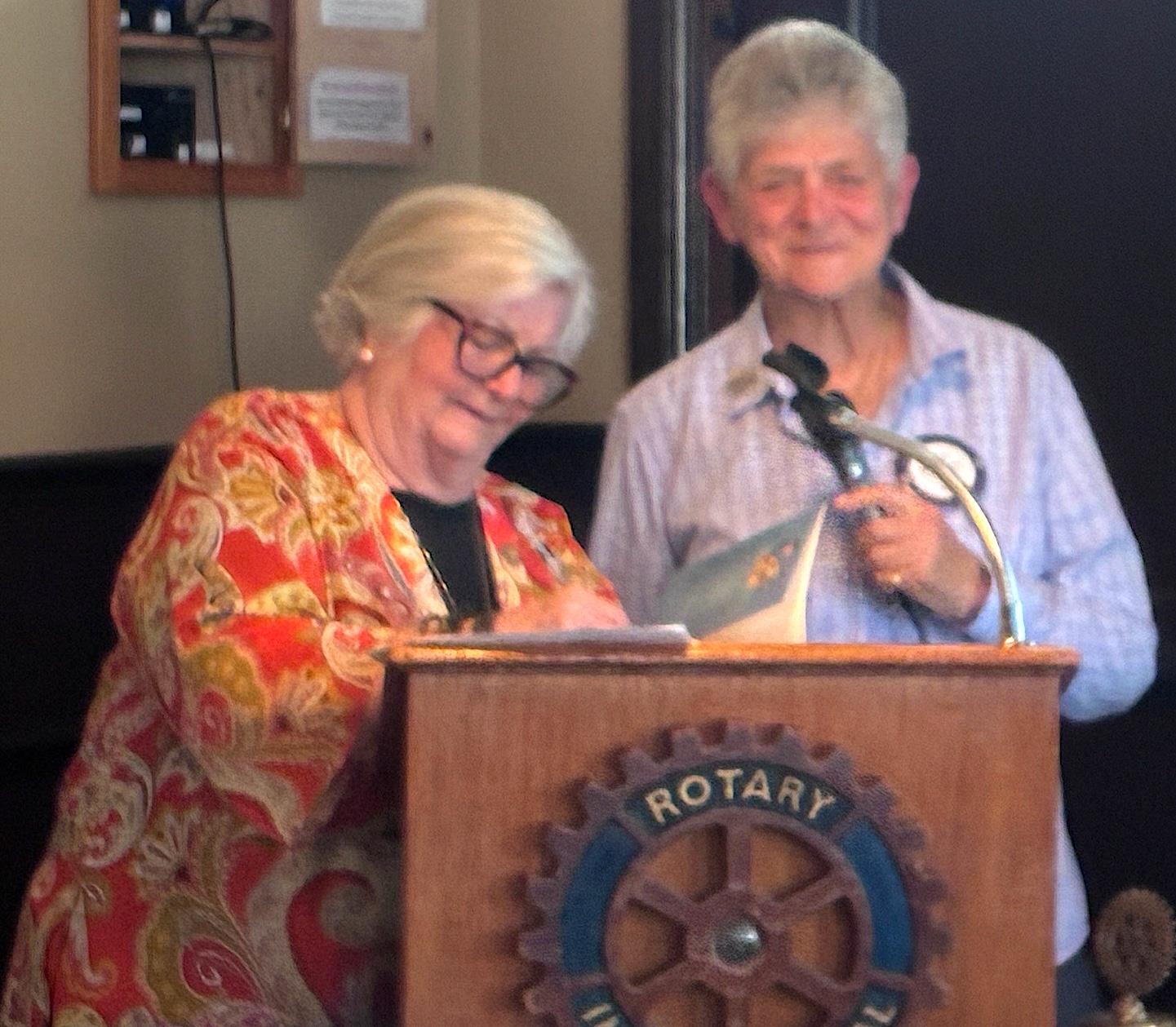
At our July 21, 2025 Rotary Meeting, the inspiration was provided by Patsy Good: Unite for Good.
Our guests this evening:
Dean Rohrs, an Afro-Canadian Rotarian who is introduced in detail below,
Past District Governor and current District Finance Director, Bev Harrington,
Past District Governor David Lukov,
and new International Project Alliance and Youth Engaged in Service Coordinator, Bernie Halliday.
Marty talked about the structure of Rotary as a pyramid, but not a pyramid scheme, with the club level at the base, then districts, zones, and finally Rotary International. Dean Rohrs is active in all these levels.
Marty introduced our guest speaker for the evening Dean Rohrs.
Dean grew up in Zambia, Africa and has lived in other countries in Africa. In Africa she was involved in Rotary and officially joined in 1989 after women were allowed. She and her husband Rhino moved to Vancouver, and she is presently the president of her club Rotary Club of Langley Central. At the district level Dean is a past DG, presently serves as the foundation chair and is the chair of President Elect Learning (Zone level). At the RI level she has been a director, trustee and vice president of RI. She also served as president of the RI Foundation: Canada. As you can see, she has had extensive Rotary experience. I don’t know Dean at all personally, but I have heard her speak a number of times and I sit up and listen. So when she offered at district assembly to come speak to clubs, I took her up on it. I invited DGs because of their vast experience and dedication and some of my questions are district-related. Bernie herself has decades of experience and is the president of the IPA and district chair for YES. Dean asked me to make it fun, and I thought wow, how am I going to that? The format is informal and more town hall with open-ended questions. I am expecting lively dialogue with all the experience in the room.
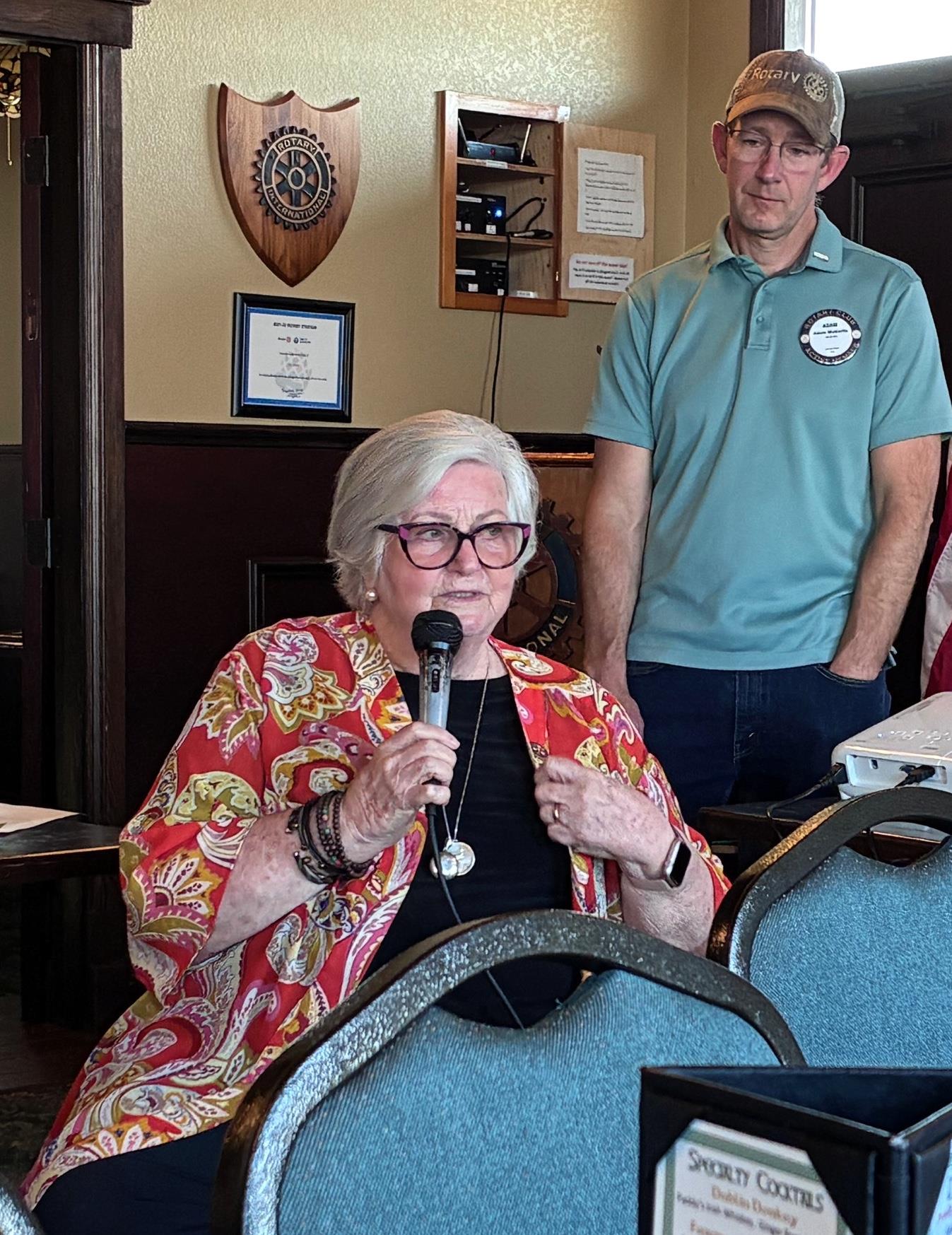
Four Way Test Marty’s experience: Marty had not heard the 4-Way Test at our club, but did when she visited other clubs. It didn’t mean much to her until she really stopped and read the questions. It has become the most important part of her being a Rotarian. It’s apolitical and is really a moral compass. She said the hardest one for her is question 3: Of the things we think, say or do: Will it build goodwill and better friendships?
In Marty’s observation, the people who join our club and stay are the ones who have this moral compass.
Marty announced that the meeting would be informal. She had a list of questions that she and other members wrote that she would ask Dean Rohrs and the other guests but she would also open the floor to everyone else. Below is a sample of SOME of the discussion:
Question 1: How do you see the 4-Way test or what does it mean to you?
Dean: Well, let’s take a step back and look at Rotary International. We are an organization of 1.4 million members right across the world, more than 200 countries. We have different cultures in every country. Every culture has a different way of doing things, but we all have a moral compass. So, in the 1950s when the 4-Way was devised, this was an answer to a question that was being asked: What does our flag signify? What do we stand for? We are one of the first and foremost organizations that are defined by the ethical compass under which we operate. The 4-Way Test was an answer to that question because it really lays out a common language in a way that every culture, every language, and anyone in the world can understand. It doesn’t matter which religion you belong to. That is the tenet of your family. It doesn’t matter what organization you work in, that is the tenet of what could be done.
Dean talked about being the RI representative to the funeral of Sam Owori, who died before taking on the office of RI President. He is the only non-federal, non-government person honored by a State funeral in Uganda. The president of Uganda said the 4-Way Test on Sam Owori’s casket needed to be put up in parliament to be honored every time they meet.
David: It’s a mirror.
Bernie: Needed the questions to make it make sense. It’s the things we think, say, and do.
John: Haggen’s. Went back in to pay for Drambuie.
Lori: Young people, it’s a great way to think about other people rather than yourself
Question: What is the most fun experience in Rotary?
Dean: Clubs surprise me on my visit as District Governor. One club had their meeting in the middle of a food court in Vancouver. Dean spoke and the club collected new members from people who happened to be listening. Make meetings fun and exciting.
Two presidents swapped meetings.
Christi: Snacks for schools. Community got involved. People donated at Tillinghast, happy kids.
Audrey: Honduras kids hugging our volunteers.
Danielle: Group Study Exchange young doctor who got to observe a new procedure in the operating room in Vancouver. Rotary opens doors.
Connie: Past District Governor Dad at District Conference at Tulalip…
Dean: GSE to New Zealand coal mine, where everyone got covered in coal dust. The miners were told that the one man was a Chippendale, and got his autograph.
Question: At District Assembly you asked us to be innovative. What do you do at your club, Dean?
Dean: We no longer sing the national anthem. We don’t have business meetings, we have a club update. Every month we have a social.
In Taiwan, the relationship is between clubs, not just within a club.
Care club: Any member who is not at the club meeting is contacted.
Bernie: Raffle and sergeant at the end of the meeting. Kids at meeting, toys, and badges.
Bev: Encourage people to come with their kids. Very welcoming.
David: Mount Vernon: Programs were all about the community. Now we’re helping people with skills like public speaking, how to deal with conflict, public image. Get the word out that we exit and we’re a fun club.
Marty: Field trips, socials
Dean’s club meets twice. Wednesday formal, Friday at the pub for lunch.
John: Be careful about making changes, know your audience.
Question: What difference does the District make for me? How is the district making changes?
Dean was on a new governance committee to think outside the box for RI.
Clubs can do that too. The club sells the product that the community needs
Rules and regulations that keep us going in the same direction.
Everyone should go to District Assembly. “I wish I could make every single member from every single club go to District Assembly because we could build a unity within the district that would be a power source. Membership would grow. If you go to Taiwan, where you have a district of 3,000 people, 5,000 people will attend district conference. That is the power of learning and the power of education, and the power of being involved.